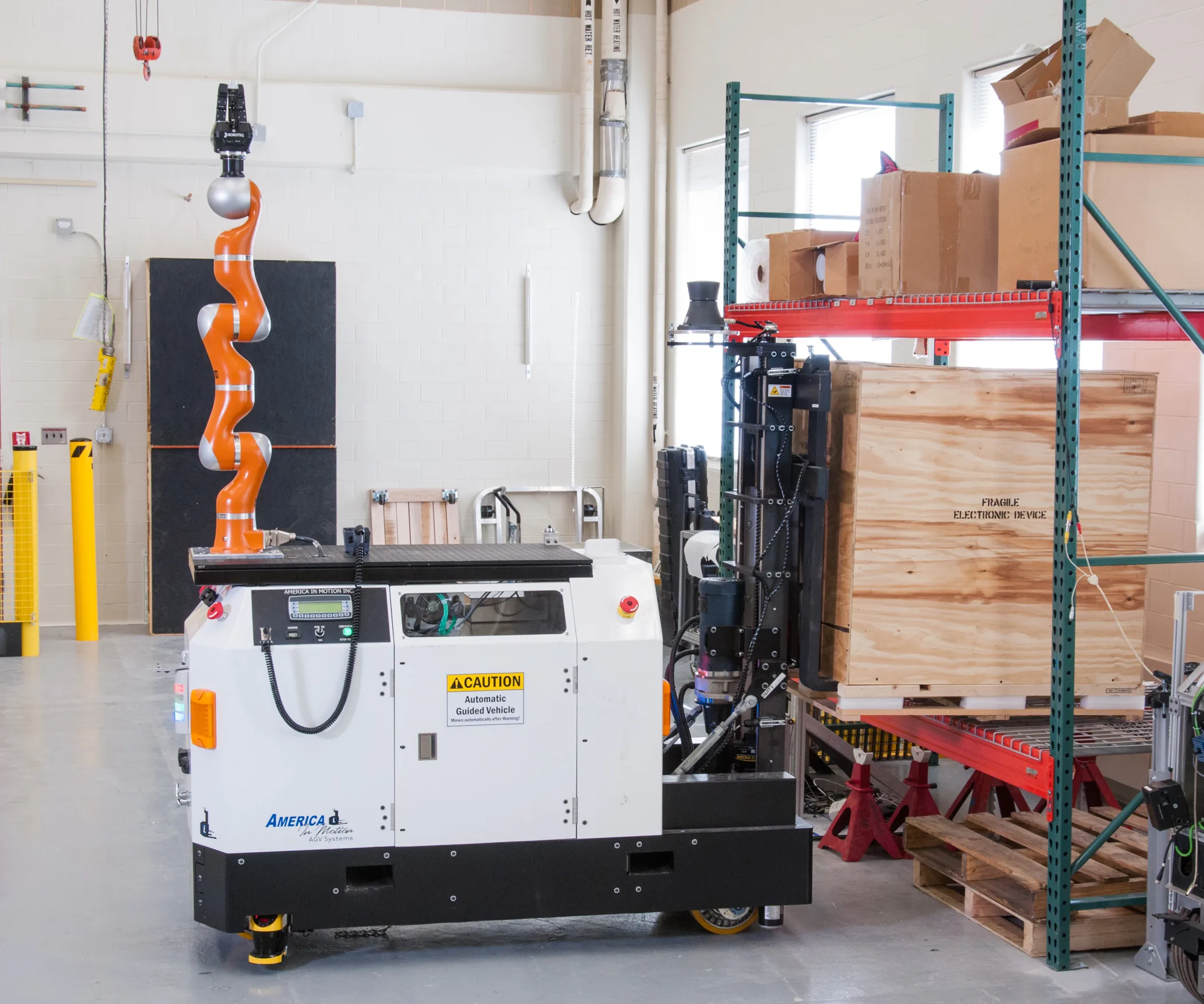
An autonomous mobile robot (AMR) generally plans its movement through permitted space, while an automated guided vehicle (AGV) generally follows engineered routes. In a warehouse, that makes AMRs useful candidates for variable destinations and routes with usable alternatives, and AGVs useful candidates for stable, repetitive transport. The decisive question is how the installed system handles your loads, traffic, and handoffs.
The labels overlap. An AGV need not follow tape, and an AMR need not have unrestricted freedom to move. Compare the actual navigation behavior and complete transport task before treating either name as a performance specification.
On This Page
- Architecture and navigation
- Warehouse comparison
- Transport performance
- Integration and docking
- Operating limits
- Mission selection
Architecture: separate locating, routing, and handling
Three functions explain most of the AMR vs AGV distinction:
- Localization: estimating the vehicle's position and orientation.
- Route and motion planning: deciding where it may travel and how to reach the destination.
- Load handling: acquiring, carrying, and releasing the pallet, tote, rack, or cart.
These functions can vary independently. A vehicle can locate itself with a laser yet follow a predefined route. NIST's 2015 navigation research already described AGVs using onboard vision for mapping and localization alongside the more familiar centrally commanded paths. A sensor name alone cannot tell you who chooses the route.
Daifuku's 2026 explanation of mobile-robot terminology describes the present overlap: some AGVs have dynamic routing, while some AMRs use positioning markers or grids. It also distinguishes changing between two engineered routes from planning a new trajectory. Ask which of those behaviors a proposed system actually supports.
For a concrete AMR implementation, OMRON's Mobile Robot Software Suite guide, revision B describes a global path toward a goal, local adjustments around unexpected obstacles, and global replanning when necessary. Configured preferred routes influence movement; forbidden areas remain excluded. This is a documented software example, not a promise about every AMR.
Finally, reaching a coordinate is different from transferring a load. A fork vehicle, roller deck, and tugger need different receiving arrangements even if they share navigation software. Specify the load and the receiving station alongside the route.
Side-by-side: what changes on the warehouse floor
The table compares conventional route-following AGV operation with AMR operation that permits local replanning. It describes operating patterns rather than every product sold under those labels. The navigation basis is the Daifuku and OMRON documentation above and SSI SCHAEFER's account of fixed-route and zone-based navigation, checked September 6, 2026. The verification questions are editorial synthesis.
| Warehouse condition | Route-following AGV | AMR with local replanning | What to verify |
|---|---|---|---|
| Repeated transport between fixed stations | Engineered paths give a predictable travel pattern | Can also operate along preferred or constrained routes | Completed cycles and delivery timing under the same demand |
| Temporary obstruction | Typically stops; an alternate route requires supported routing logic | May detour within permitted space | Whether a loaded vehicle has enough clearance to pass |
| Changed destination or layout | Route configuration needs review; physical guidance changes depend on the design | Goals, map, and travel restrictions need review | Time and work needed to recommission the affected task |
| Narrow aisle with no bypass | Waits or uses an available alternate route | Replanning cannot create physical space | Queue behavior and who clears the obstruction |
| Precise station handoff | Requires suitable docking and handling equipment | Requires suitable docking and handling equipment | Repeated successful transfer with representative loads |
SSI SCHAEFER identifies stable recurring flows as a natural AGV application and variable environments as an AMR application. Use that distinction to shortlist an architecture. Throughput, payload capability, and ownership cost still require candidate-specific evidence.
Performance: count completed transfers, not top speed
Define a transport cycle from the moment a vehicle becomes available for pickup until it is available for its next equivalent task. Include travel, docking, loading, unloading, and waiting. Otherwise, a fast empty run can conceal the delay that actually limits deliveries.
NIST's work on AGV performance testing explains why task-based comparisons matter: navigation, obstacle negotiation, docking, and environmental conditions need measurable tests. A safety assessment and a throughput measurement answer different questions.
Consider a hypothetical screening example, with all times expressed in seconds:
Cycle time = travel + docking and transfer + waiting.
If those inputs are 120 + 60 + 60, the cycle takes 240 seconds. A continuously available vehicle could then complete 3,600 ÷ 240 = 15 cycles per hour. Reducing travel to 90 seconds gives 210 seconds and approximately 17.1 cycles per hour. Eliminating the assumed 60-second wait instead gives 180 seconds and 20 cycles per hour.
These are illustrative calculations using assumed times, not measured robot results or fleet forecasts. They assume one completed transfer per cycle and exclude charging and outages. Identifying a waiting bottleneck may therefore matter more than selecting a faster chassis. An AMR detour is valuable when it reduces the complete cycle time; a longer trip around an obstruction is not automatically an improvement over a short wait.
For a site trial, give both candidates the same loads, destinations, and task-release pattern. Record completed transfers per hour, late deliveries, station queues, interventions, and time unavailable for charging or recovery. Include a busy operating period. Multiplying an isolated vehicle's rate by the fleet size assumes away shared aisles and stations.
Integration: connect the transport job to the handoff
Write down what constitutes a completed delivery. A useful integration contract names the load, pickup location, destination, dispatch acknowledgment, station readiness, transfer confirmation, and failure response. Decide which system owns each state: the warehouse management system (WMS), execution software, fleet manager, vehicle, or station controller.
For example, a robot arriving at a conveyor should not cause inventory to be recorded as delivered before the transfer is confirmed. Ask the integrator to demonstrate an occupied destination and a transfer interrupted midway. Specify how the system determines where the load is before retrying the job. These are proposed acceptance scenarios, not a statement that every supplier implements the same interface.
Docking deserves its own test. The published scope of ASTM F3499-21 covers repeatable positioning at a location or relative to a dock across different navigation methods and handling mechanisms. It explicitly distinguishes navigation sensors from sensors used locally for docking.
The practical implication is to request loaded docking results at the intended stations. Define the permitted position and orientation error from the receiving equipment's requirements, then verify successful transfer. Do not substitute a general navigation-accuracy number for this task.
What VDA 5050 does and does not solve
VDA 5050 version 3.0.0, March 2026, defines a communication interface between fleet control and mobile robots. It uses JSON messages over MQTT, a publish-and-subscribe messaging protocol. The recommendation accommodates differing navigation approaches.
Its scope explicitly excludes traffic-management algorithms, safety requirements, peripheral and external IT interfaces, and cybersecurity measures. Consequently, a claim of VDA 5050 support is not proof that two fleets will avoid deadlock, share a conveyor, or connect to a WMS without additional integration.
Specify the exact supported version and functions, then demonstrate the required combination of robot, controller, and station. Include lost communications and restart in the demonstration. The interface provides a common vocabulary; the project still needs working behavior.
Make commissioning and support part of the comparison
Use the same commissioning questions for both proposals. Start with a representative load, including its carrier and any overhang. Ask the integrator to show the full swept space through a turn and the approach to each station. An unloaded chassis passing an aisle proves little about a long cart train or a pallet extending beyond the platform. Record which load configurations were demonstrated and which remain outside the proposed installation.
Next, walk through a delivery from dispatch to completion with the warehouse team. Agree what happens when the pickup is empty, the load identifier is wrong, or the receiving station rejects the delivery. In a controlled demonstration, submit the same job again after a simulated communications interruption. The system should show an unambiguous job and load state before another movement is requested. The purpose is to establish the project's behavior, rather than assume that a robot API supplies the warehouse's business rules.
Treat charging as an operating task. Ask where a vehicle waits if its charger is occupied, how a low-energy vehicle is removed from dispatch, and how the team distinguishes an unavailable vehicle from one merely waiting for work. Request the charging arrangement used in any proposed throughput calculation. Count time connected to a charger, waiting for it, and returning to service within the same reporting window.
Finally, assign ownership of routine changes and faults. Who updates a map or engineered route after racking moves? Who checks that the receiving station still aligns? Which employee may recover a stopped vehicle, and what supplier procedure governs that action? Obtain the permitted recovery method for the loaded configuration, required equipment, training scope, maintenance schedule, and support escalation path.
These are proposed project questions derived from the distinction between navigation, docking, fleet communication, and the operating zone. Document the answers in both suppliers' scopes. That makes a comparison of integration effort meaningful without assuming that either architecture is always simpler to install or maintain.
Limitations: autonomy needs a usable operating environment
Dynamic obstacle avoidance is useful only when an acceptable route exists. A blocked doorway or a pallet filling the only aisle can stop either architecture. Define where waiting is acceptable, where alternative travel is permitted, and how an operator retrieves an immobilized loaded vehicle.
Localization is another limit. The OMRON guide explains that changed surroundings can stop sensor observations matching the map, and documents a lost-position state that requires attention. A warehouse assessment should therefore include both sparse and densely stocked conditions, followed by an agreed process for map changes and recovery. Do not infer reliability from one empty-floor demonstration.
Safety requirements also extend beyond the choice of navigation. ISO 3691-4:2023 covers driverless industrial trucks and their systems, expressly including AGVs and AMRs among its examples. Its published scope identifies the operating zone as significant to safe operation.
That means an AMR label does not, by itself, answer whether a shared aisle is suitable. Have the installed application assessed with its actual loads, transfer points, people, and other traffic. The standard is not a universal legal approval, and establishing compliance for a particular installation requires more than its public abstract. Freezer service and other severe conditions also introduce hazards outside the scope identified in that abstract.
Choose around the transport mission
For a stable pallet or cart shuttle, begin with the route-following option as a serious candidate. Require the planned transfer rate and reliable station handoffs. Extra route freedom has little value if all useful movement is already confined to one clear corridor.
For variable tote deliveries or replenishment among multiple stations, evaluate AMR replanning where alternate paths are physically usable. Make the demonstration include the disruption that motivates the purchase, such as an occupied route. Measure whether the remaining deliveries continue on time.
For rack pickup or conveyor transfer, let handling geometry and repeated docking success control the shortlist. Route flexibility cannot compensate for an incompatible load carrier or receiving station.
For a mixed fleet, establish one coherent traffic arrangement and prove the interfaces required by the actual missions. Shared protocol support is only part of that work.
These are conditional engineering recommendations drawn from the navigation, docking, and interface distinctions above. Before choosing either architecture, request the same mission trial and an itemized deployment scope covering vehicles, stations, software, site preparation, charging, maintenance, and recovery. If the main problem is obstructed aisles or unready receiving stations, correct that process first and reassess the transport requirement.
Sources
- Daifuku: Mobile Robots, AGVs and AMRs. Manufacturer explanation, April 28, 2026; overlapping terminology and navigation approaches.
- NIST: Navigation Performance Evaluation for Automated Guided Vehicles. Original research record, 2015; navigation methods and measured performance.
- OMRON: Mobile Robot Software Suite User's Guide. Revision B, chapters 9 and 10; path planning, configured restrictions, and localization limits for the documented software.
- SSI SCHAEFER: AGV and AMR differences. Manufacturer explanation of recurring transport, route guidance, and zone-based movement.
- NIST: Automated Guided Vehicles Ripe for Standardized Performance Tests. Institutional account, 2014; task-based navigation, docking, and environmental comparisons.
- ASTM F3499-21: Docking Performance of A-UGVs. Official standard scope; docking measurements across navigation and load-transfer methods.
- VDA 5050, version 3.0.0. March 2026 recommendation; fleet-control communication and explicit scope exclusions.
- ISO 3691-4:2023. Official published scope of the driverless-industrial-truck safety standard; the full standard was not used for clause-level compliance advice.
Last checked: September 6, 2026.