A VTOL fixed-wing aircraft transitions by building forward airspeed while shifting support from powered rotors to its wing. At the same time, the flight controller changes how motors and aerodynamic control surfaces govern attitude. The reverse transition restores powered lift as the aircraft slows for a vertical landing. Success requires enough lift and steering authority throughout the change, not merely a command to enter airplane mode.
VTOL means vertical takeoff and landing. Here it describes winged aircraft that combine vertical operation with airplane-like cruise. The details depend on the propulsion arrangement and flight software; the implementation examples below refer specifically to PX4 v1.16.
On This Page
- What moves during transition
- How the wing takes the load
- How the controller changes authority
- Why landing needs a separate transition
- What can interrupt the handover
- Where the tradeoff pays off
- What to ask about an aircraft
What moves during transition
The first distinction is whether the aircraft changes thrust direction, changes which propulsion system is active, or rotates its entire body.
| Architecture | How it changes from hover to cruise | Main integration tradeoff |
|---|---|---|
| Lift-and-cruise, often called a QuadPlane | Dedicated lift rotors support vertical flight; a separate pusher or puller accelerates the aircraft | Separate propulsion simplifies functional separation but adds hardware and weight carried in cruise |
| Tiltrotor | Propulsion units rotate from an upward thrust direction toward a forward direction | Reusing propulsion requires a tilt mechanism and coordinated actuator motion |
| Tailsitter | The whole aircraft pitches from its upright takeoff attitude toward its cruise attitude | Fewer dedicated tilt mechanisms, but challenging hover and transition aerodynamics, especially in wind |
| Tilt-wing | The wing and its attached propulsors rotate relative to the fuselage | Wing angle, propeller flow, and mechanical loads must be coordinated across the maneuver |
Source basis: PX4's VTOL architecture overview and the NASA GL-10 flight-testing report. These are configuration distinctions, not a ranking of aircraft performance.
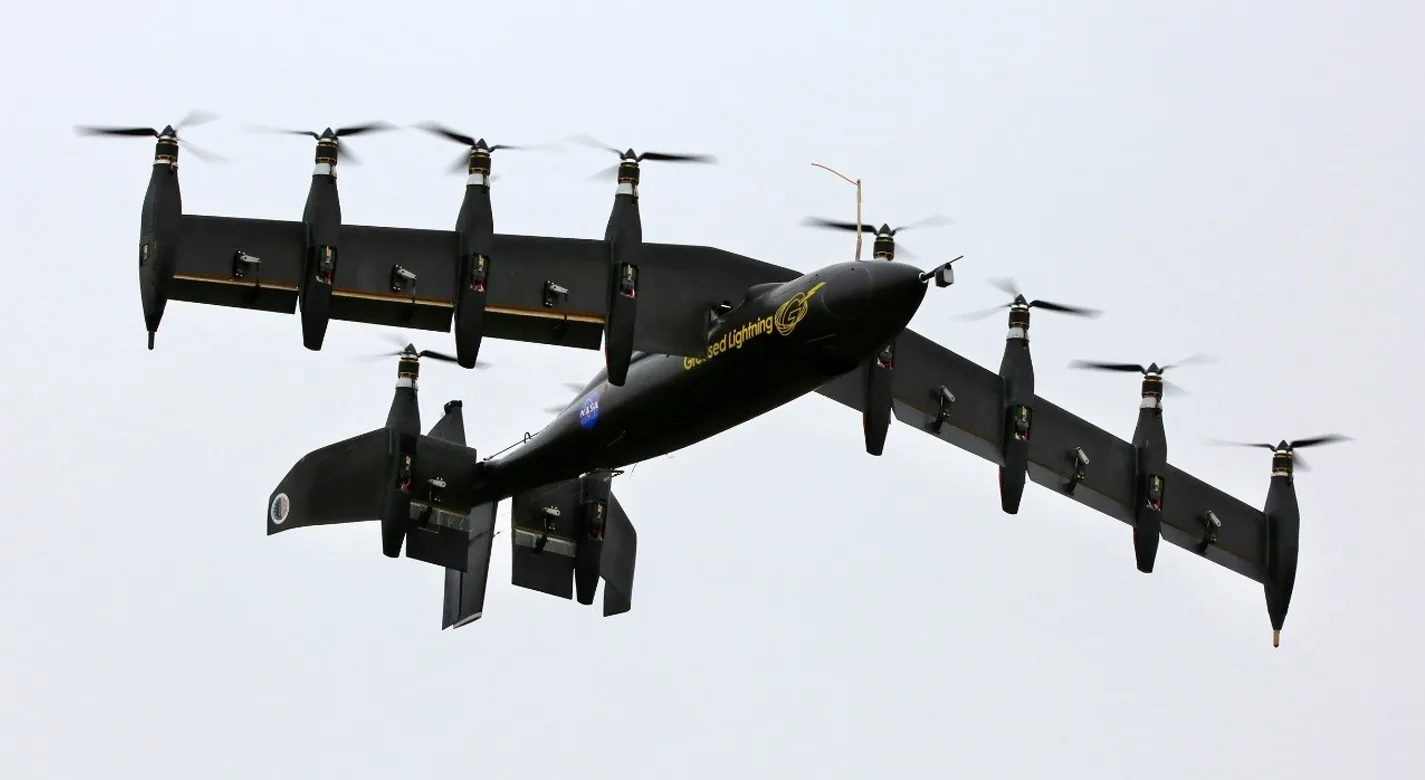
A tilt-wing remains in this family because it uses wing-borne cruise, even though its wing moves relative to the fuselage. NASA's GL-10 research aircraft, shown in the featured photograph, illustrates that arrangement. It should not be treated as interchangeable with a tiltrotor, where the propulsion unit tilts without requiring the whole wing to rotate.
How the wing takes the load
In a steady hover, the upward forces must balance aircraft weight. During acceleration, the aircraft must continue supporting itself while also creating forward force. Tilting thrust forward reduces its upward component unless total thrust or aerodynamic support changes to compensate.
For the wing, NASA's lift equation expresses the relevant dependencies:
Lift = 0.5 × air density × airspeed² × wing area × lift coefficient.
With density, area, and lift coefficient held constant, doubling airspeed produces four times the lift. That is a relationship, not a transition-speed prescription: wing inclination and flow conditions change the lift coefficient during the maneuver. Propeller wash can provide airflow over parts of the wing before substantial forward speed develops. The wing's contribution therefore does not suddenly begin at one switch point.
The aircraft therefore needs a viable path through intermediate conditions. NASA's GL-10 report describes a transition corridor bounded by constraints including insufficient vertical force and wing-tilt actuator loading. A corridor relates speed to aircraft configuration; it is more informative than a single time or speed limit. Those particular boundaries belong to the GL-10 research configuration and cannot be copied into another aircraft's settings.
A lift-and-cruise example
In the PX4 v1.16 QuadPlane implementation, the pusher or puller accelerates the aircraft while it is still transitioning from multicopter flight. As the configured blending airspeed is approached and exceeded, control authority can progressively move toward fixed-wing control. Reaching the configured transition airspeed triggers the change into fixed-wing mode.
That airspeed must provide a suitable margin above the airframe's stall speed; it is not a universal value. The documentation also describes transition without airspeed feedback using an elapsed-time setting. An elapsed timer establishes that time has passed, rather than measuring the wing's aerodynamic readiness.
Groundspeed cannot substitute blindly for airspeed
The wing responds to motion relative to the surrounding air. Satellite-derived groundspeed describes motion relative to Earth. Wind separates the two, as the PX4 guide to operation without an airspeed sensor explains.
For a simple illustrative case, assume straight flight aligned with a steady wind and a groundspeed of 15 metres per second. A 5 m/s tailwind gives 10 m/s airspeed; the same-strength headwind gives 20 m/s. These assumed values demonstrate the distinction and are not aircraft operating limits.
The v1.16 guide labels sensorless VTOL support experimental and recommends an airspeed sensor. A supplier using another approach should explain how it determines adequate airspeed, what conditions the approach covers, and what happens when the estimate becomes unreliable.
How the controller changes authority
The control system has two connected responsibilities: estimate the aircraft's state and assign corrective action to the available actuators. A motor speed controller, a surface servo, and a tilt actuator affect the aircraft differently, and their usefulness changes through transition.
PX4's controller diagrams show multicopter and fixed-wing controllers joined by VTOL switching and blending logic. The resulting force and torque requests pass through an airframe-specific control allocator, which translates them into actuator outputs. Control surfaces generally become more effective as airflow increases, so the same surface movement need not produce the same response in hover and cruise.
The software arrangement also differs by airframe. In the documented standard and tiltrotor transition, the fixed-wing attitude controller supplies angular-rate targets to separate rate controllers. During tailsitter transition, the multicopter attitude controller runs. Treating all three as an identical percentage blend would obscure a real implementation difference.
The operator interface must show the actual state
The MAVLink common message definitions distinguish a transition request from reported vehicle state. MAV_CMD_DO_VTOL_TRANSITION requests a target configuration, while EXTENDED_SYS_STATE can report multicopter, fixed-wing, or either transition direction.
For integration, examine three boundaries:
- Command to flight controller: Which component requests transition, and how are acceptance or rejection communicated?
- Controller to actuators: Which motors, surfaces, and tilt mechanisms receive commands, and what feedback confirms their response?
- Aircraft to operator: Does the station display the current transition state, airspeed validity, and an interrupted maneuver distinctly?
These questions matter when a ground station, companion computer, and autopilot come from different suppliers. A shared protocol name alone does not establish support for the necessary command, state messages, or behavior.
Why landing needs a separate transition
Back-transition must reduce forward motion while rebuilding the powered lift and control needed for vertical flight. Starting it over the touchdown point can leave the aircraft still travelling beyond that point.
The PX4 v1.16 back-transition guide describes pitch-up assistance for deceleration and a mission calculation that uses current velocity and expected deceleration to choose where to start the maneuver. It also describes a period with altitude control but no position control, during which drift can occur.
Transition completion and a stationary hover are different conditions. In this implementation, back-transition can end when horizontal speed reaches the configured multicopter cruise speed or when its duration expires. Neither condition means the aircraft has necessarily stopped over the landing point.
The resulting planning implication is to assess the approach path and stopping space alongside the landing pad. A site may accommodate vertical touchdown yet lack a suitable approach for the aircraft's actual wind conditions, braking behavior, and recovery options. Outbound acceleration and inbound braking need separate evidence; successful takeoff transition does not establish the landing approach.
What can interrupt the handover
Failures become clearer when separated by the function they remove. The table combines the cited transition, control, and failsafe documentation into engineering questions; it is not an emergency checklist for a particular aircraft.
| Problem | Why it matters during transition | What to establish for the installed system |
|---|---|---|
| Insufficient forward acceleration | The wing may not become ready to carry the load | Completion criteria, transition timeout, and available fallback |
| Incorrect or unavailable airspeed | Transition timing or control scaling may rely on an unreliable input | Sensor validity checks and the permitted fallback method |
| Tilt mechanism or control-surface fault | Commanded configuration or corrective moment may not occur | Fault detection, remaining control authority, and recovery limits |
| Inadequate lift propulsion or power | Returning to hover may no longer provide enough support | Available thrust and energy at the actual payload and battery condition |
| Unexpected deceleration or drift | The aircraft may finish back-transition beyond the intended approach area | Stopping behavior and the space needed for a revised landing approach |
PX4 calls an emergency change from fixed-wing to multicopter flight a quad-chute. Its v1.16 failsafe guide describes configurable responses after the switch, such as return, land, or hold, and triggers involving altitude loss or excessive attitude. Despite its name, this function does not itself deploy a parachute.
A commanded return to hover is only useful if the required propulsion, control, navigation, and power remain available. A pusher failure on a lift-and-cruise aircraft and a shared electrical failure are therefore different recovery problems. The latter may affect the very motors needed for the fallback. This is an engineering consequence of the dependencies, not a claim that a particular design has suffered either failure.
Where the tradeoff pays off
The attraction is combining a compact takeoff and landing area with wing-borne travel. The costs include additional hardware or moving mechanisms, transition complexity, and an energy budget that must cover vertical recovery as well as cruise.
NASA's Greased Lightning technology description identifies field surveys, surveillance, and industrial inspection as potential applications. It also describes an intended hybrid-electric arrangement in which batteries provide a power boost for vertical flight and hover. These are a research concept's proposed uses and design features, not proof of a current commercial service or a general endurance advantage.
For a large-area survey launched from restricted terrain, the combination may be useful because much of the mission can occur in forward flight. For inspection requiring sustained close hovering, the team should examine hover control and energy consumption first. For a mission already supported by a suitable runway or launch-and-recovery system, a conventional fixed-wing aircraft may avoid the additional transition hardware.
Those are scenario-based selection implications. Compare the actual payload, wind conditions, flight profile, takeoff and recovery method, and remaining energy requirement before drawing a performance conclusion. A cruise-only figure cannot establish whether the complete mission can finish with a vertical landing.
What to ask about an aircraft
Ask the supplier or integration team to explain one complete outbound and inbound transition using the intended hardware, software version, payload, and operating conditions. The explanation should identify what supports the aircraft at each stage, which actuators control it, what confirms completion, and what remains available after an interruption.
Then ask for the demonstrated operating envelope, meaning the combinations of payload, speed, configuration, and conditions that have been established for the aircraft. Review the recovery space and energy it requires. The useful capability is a controlled passage through every intermediate condition, followed by a recoverable landing with the mission load still aboard.
Sources
- PX4 v1.16: VTOLs Project manual describing propulsion arrangements and broad configuration tradeoffs.
- NASA: Greased Lightning (GL-10) Flight Testing Campaign Technical memorandum NASA/TM-2017-219643; the transition-corridor discussion identifies vertical-force and tilt-actuator constraints for the research aircraft.
- NASA Glenn: Lift Equation Aerodynamics reference defining the wing-lift relationship and its variables.
- PX4 v1.16: QuadPlane Configuration and Tuning Implementation manual covering acceleration, blending, transition airspeed, and time-based criteria.
- PX4 v1.16: VTOL Without an Airspeed Sensor Project guidance explaining airspeed versus groundspeed and the experimental status of sensorless operation in this version.
- PX4 v1.16: Controller Diagrams Flight-control documentation explaining VTOL controller selection, allocation, and surface effectiveness.
- MAVLink: Common Message Set Protocol definitions for transition commands and reported VTOL state.
- PX4 v1.16: Back-transition Tuning Implementation guidance on braking, completion conditions, and approach distance.
- PX4 v1.16: Safety Configuration Project manual defining quad-chute triggers and configurable responses.
- NASA: VTOL UAV With the Cruise Efficiency of a Conventional Fixed Wing UAV Agency technology description of the Greased Lightning concept, potential applications, and the credited featured photograph.
Last checked: September 6, 2026.