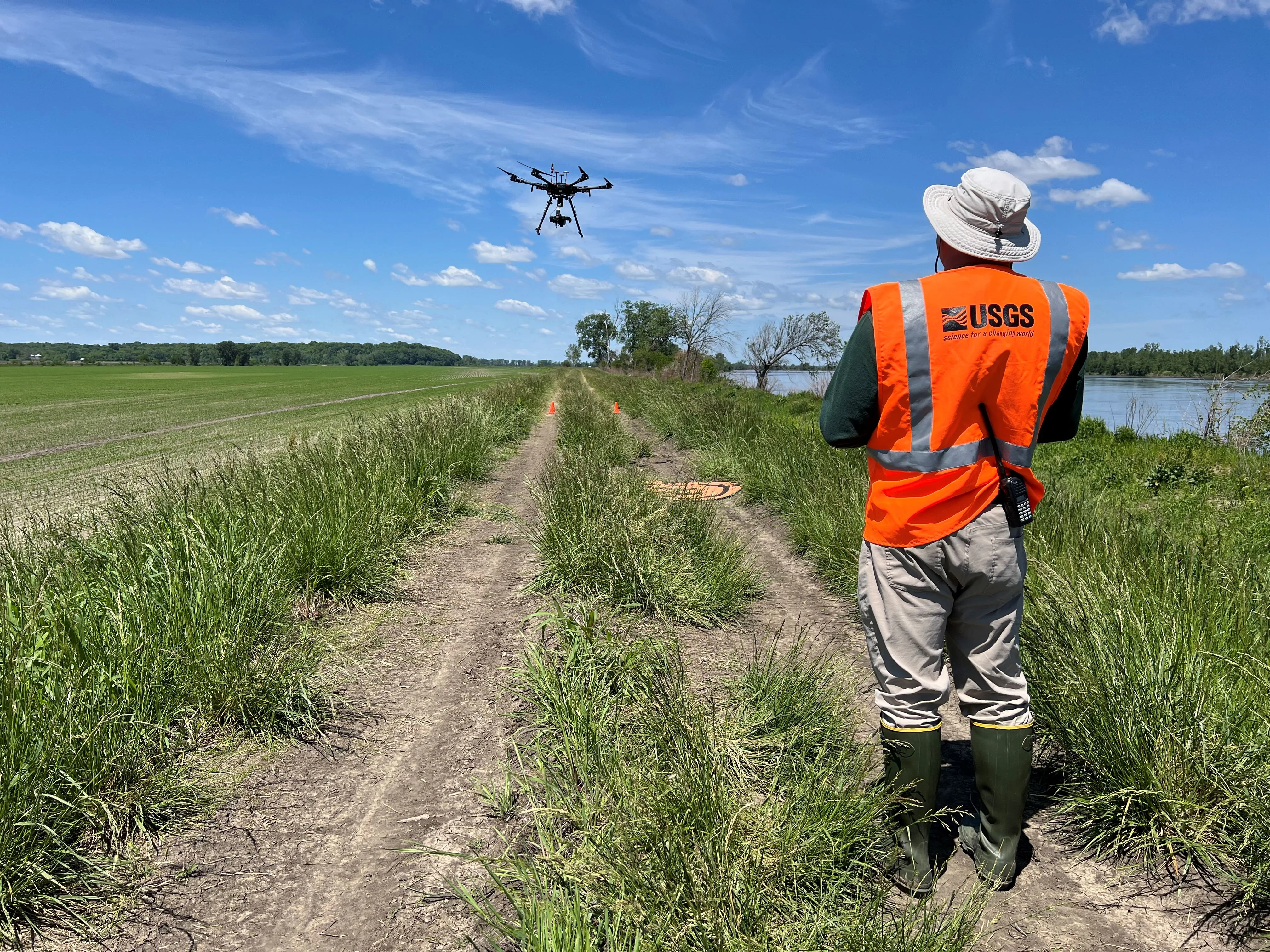
Multirotor UAS suit missions that need hovering, slow repositioning, and close inspection. Fixed-wing UAS suit missions dominated by forward travel, such as broad-area mapping and corridor surveys, provided the aircraft has a workable launch and recovery method. The decisive difference is how they support their weight: a multirotor relies on powered rotors, while a conventional fixed-wing aircraft relies mainly on airflow over its wings.
A hybrid aircraft with vertical takeoff and landing (VTOL) can combine rotor-supported departure with wing-supported cruise. That expands the operating options, but adds transition requirements and configuration-specific compromises. Start with the sensor's job and the available recovery space before comparing flight-time figures.
On This Page
- Architecture and comparison
- Useful mission time
- Sensor and flight-path integration
- Recovery and degraded operation
- Hybrid VTOL tradeoffs
- Choosing for the mission
How the architectures differ
A conventional multirotor changes individual rotor thrust to control its attitude and movement. It can remain over a point without flying a continuous circuit. That makes stopping to examine a feature possible, although actual position holding depends on the aircraft's navigation and control system. For example, PX4's multicopter Hold mode stops and hovers, whereas its fixed-wing Hold mode circles a location. Both require a valid position estimate.
A fixed-wing aircraft needs sufficient airflow and an appropriate angle of attack to generate wing lift. Airspeed is speed relative to the air, so it is distinct from speed over the ground. NASA's lift equation shows why wing area, air density, airspeed, and lift coefficient all matter. A wing alone does not let a conventional aircraft stop and hover in still air.
In steady, level fixed-wing cruise, lift balances weight and thrust balances drag. A higher lift-to-drag ratio means less drag for the lift produced, helping explain the architecture's attraction for distance-intensive missions. The wing does not provide free propulsion: the aircraft still needs energy to overcome drag. NASA's lift-to-drag explanation also describes how that ratio affects gliding distance.
Architecture and mission comparison
These are class-level distinctions for conventional multirotors, conventional fixed-wing aircraft, and winged VTOL hybrids. They are not matched-aircraft performance measurements.
| Decision criterion | Multirotor | Conventional fixed wing | Winged VTOL hybrid |
|---|---|---|---|
| Stationary observation | Can hover and reposition slowly | Must keep flying; observation normally uses passes or an orbit | Hover is possible, subject to the design's operating envelope |
| Distance-intensive mission | Evaluate travel energy and time left for work | Wing-supported cruise favors sustained forward travel | Uses wing-supported cruise after transition |
| Departure and recovery | Vertical flight allows a compact footprint | Requires a suitable launch and recovery method | Vertical flight reduces reliance on a conventional landing approach |
| Sensor viewpoint | Aircraft can pause or adjust position | Sensor must work from a moving flight path | Sensor must accommodate the intended flight modes |
| Main selection constraint | Useful endurance with the installed payload | Flight-path and recovery space, plus sensor performance in motion | Transition behavior and energy reserved for vertical recovery |
Source basis: NASA aerodynamics, the multicopter research below, and PX4 v1.17's VTOL documentation. Mission-fit conclusions are engineering interpretation of those operating differences.
Compare useful mission time, not headline endurance
Endurance is time aloft; range concerns distance. Neither automatically tells you how much usable inspection or mapping data returns with the aircraft. The speed that maximizes flight time can differ from the speed that maximizes distance.
Bauersfeld and Scaramuzza's multicopter performance research models aerodynamics, motors, batteries, and wind together. Its practical lesson is that vehicle mass, propellers, drag, operating speed, and battery behavior affect performance. It also shows why hovering should not automatically be assumed to be a multirotor's most energy-efficient operating point.
For two candidate systems, request endurance in the actual payload configuration, with the same mission assumptions. Specify takeoff mass, battery or fuel configuration, collection speed, weather conditions, and the reserve remaining at recovery. Separate endurance from command-link reach: a radio-distance specification is not proof of a complete outbound-and-return mission. Do not compare one aircraft's unloaded maximum with another's loaded mission result.
For mapping, hold the required ground resolution, image overlap, and deliverable constant. Otherwise, an apparent coverage advantage may simply reflect coarser imagery or wider flight-line spacing. QGroundControl's survey documentation connects camera properties, altitude, overlap, and grid spacing, and includes extra distance for turnarounds.
A useful planning calculation is:
Data-collection time = planned airborne time minus departure, transit, turns, return, and recovery time.
Use an airborne-time budget that already preserves the required reserve. For illustration only, a 40-minute budget with 14 minutes assigned to other flight phases leaves 26 minutes for collection. Those assumed values are not specifications for either architecture. The comparison becomes meaningful when both candidates perform the same task under the same reserve policy.
Wind and terrain change the comparison
A favorable outbound leg does not establish the return budget. For an out-and-back mission, evaluate both directions rather than applying one ground speed to the whole route. The multicopter study models headwind and tailwind effects separately because wind changes both useful progress and power demand. Its constant-wind model should not be treated as a prediction of gust response around a particular structure.
Ask for distinct limits for launch, collection, and recovery. A system that can remain airborne in a stated wind may still fail to obtain the required imagery or complete its intended landing approach. For a hovering inspection, define how much movement the sensor task tolerates. For a fixed-wing survey, check the planned ground track and turnaround footprint. For a hybrid, include the transition limits as well. These questions avoid treating a single advertised wind figure as an all-mission capability.
Terrain also changes the sensor geometry. QGroundControl warns that its flat-ground planning assumption can produce different overlap when terrain differs from launch elevation. Compare the candidates using the same terrain model and required clearance, and ask how each system handles the route's climbs and descents. Ground resolution and obstacle clearance should remain mission requirements throughout the flight, rather than values checked only over the launch point.
Fit the sensor and flight path together
For a tower or facade, the controlling requirement may be a particular viewing angle and time spent examining one feature. A multirotor's ability to pause gives the operator flexibility to investigate an unexpected finding. A fixed-wing aircraft may support observation from an orbit, but that is a different viewing geometry from hovering beside a structure.
For a large survey block, ask whether the camera can deliver the required images at the proposed collection speed. A faster aircraft is useful only if image capture and the flight pattern still meet the deliverable. Small or irregular blocks also deserve attention: transit and turnarounds can occupy a larger share of the sortie than on long, uninterrupted lines. This follows from the survey geometry, rather than from a universal acreage threshold.
Camera integration goes beyond mounting a sensor. PX4 v1.17 distinguishes camera control interfaces, including MAVLink cameras and cameras connected to flight-controller outputs. It also describes gimbals that stabilize and point a camera independently of the airframe. Support for an autopilot does not establish compatibility with every camera feature.
Before selecting the aircraft, ask the integrator to document the payload mount and balance limits, electrical supply, command interface, capture timing, storage, and geotagging. For an inspection payload, also verify the available viewing angles. For a survey payload, request sample deliverables from the proposed configuration and an explanation of how image positions are recorded. These are procurement questions, not capabilities established by the airframe label.
Keep the required output specific. An operator who needs to revisit one suspect fastener has a different task from a team producing a continuous map of a corridor. In the first case, the demonstration should show access to the necessary viewpoint and a usable image of the feature. In the second, it should show complete coverage without gaps at turns or changes in terrain. Requiring the output makes the aircraft comparison about the work the system can actually complete.
Recovery space and degraded operation can decide the choice
Assess the complete flight footprint. Vertical takeoff is useful where a conventional departure or landing is impractical, but the pad is only part of the required space. Include obstacle clearance, approach, missed recovery, and any transition path in the site assessment.
A fixed wing's ability to glide after loss of propulsive thrust can be useful, but it does not guarantee a safe landing. The available height, glide performance, remaining control, and reachable terrain determine whether there is a viable recovery. A multirotor without a wing cannot rely on the same wing-borne glide. Neither observation proves that one architecture is universally safer.
Ask for the actual responses to loss of command link, degraded navigation, low energy, and propulsion faults. Require configuration-specific evidence for motor-out capability; rotor count alone is not enough to establish it. Also distinguish a commanded return from a demonstrated ability to reach and recover at the site.
For each candidate, walk through one interrupted mission: the payload stops collecting at the far end of the route. Identify the return path, remaining energy, recovery method, and information available to the operator. This exposes dependencies that an endurance number leaves hidden.
Include the ground equipment in the comparison
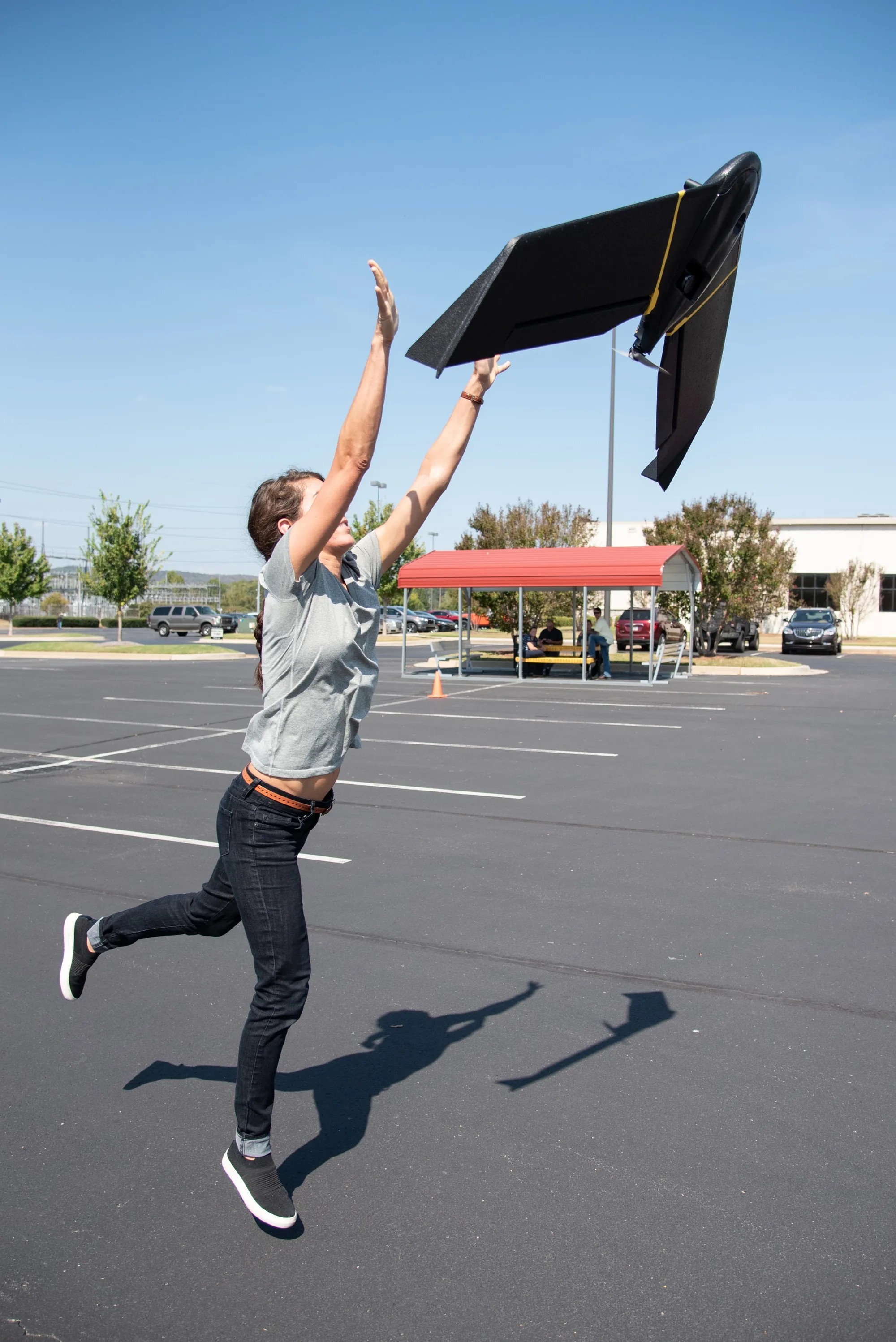
Conventional fixed-wing departure does not necessarily mean a runway. The USACE launch photograph shows a senseFly eBee X being launched by hand in 2019. It illustrates one method, not a capability shared by every fixed-wing aircraft. Establish the departure and recovery method for the particular candidate before rejecting or accepting the architecture.
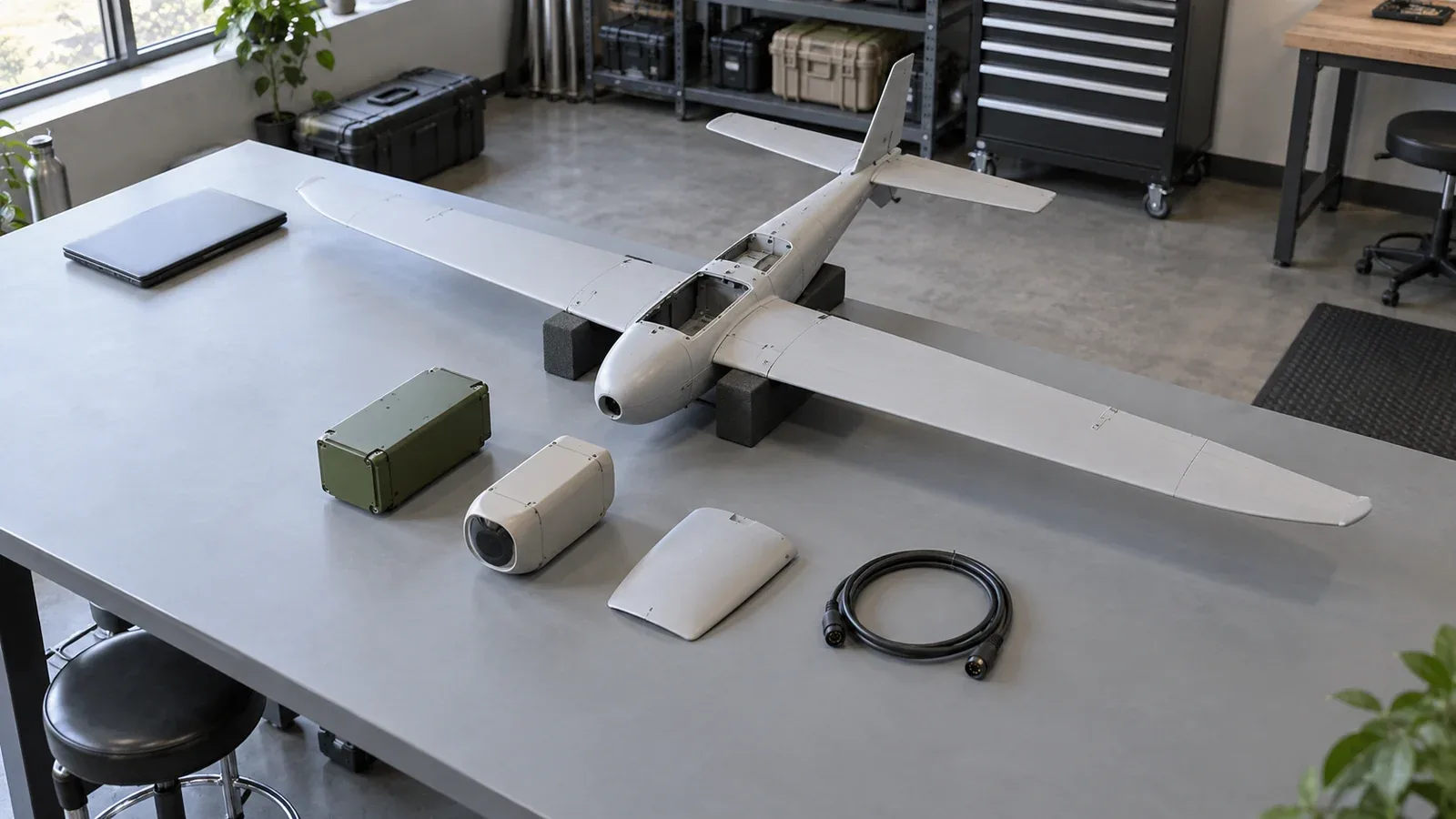
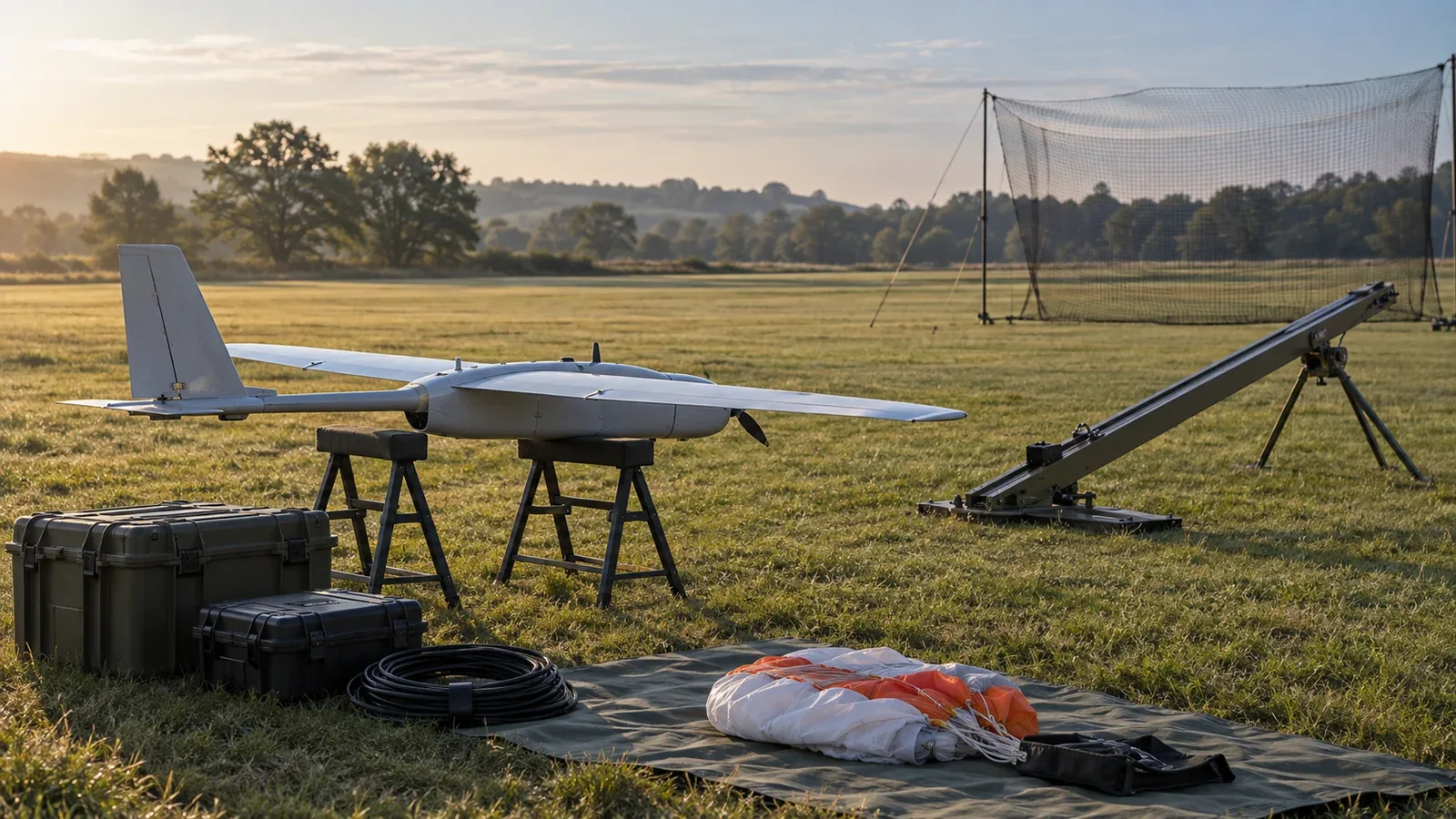
Ask each supplier to list everything that must arrive at the field site: aircraft transport cases, assembly tools, ground-control equipment, batteries and charging equipment, and any launch or recovery apparatus. Then identify the people and space needed to set up, operate, pack away, and prepare for another sortie. A longer flight can be valuable, but it does not answer whether the team can move efficiently between several separate work sites.
Record recurring inspection and replacement tasks as well. For a winged system, ask about wing attachments and control-surface checks; for a multirotor, ask about its rotor and propulsion inspections; for a hybrid, include the transition-related mechanisms where fitted. Use the actual maintenance instructions and service arrangements, rather than assuming that one architecture always costs less to support.
What hybrid VTOL adds and costs
Hybrid VTOL is a family of architectures. PX4 describes tailsitters that rotate the whole aircraft, tiltrotors that redirect propulsion, and configurations with separate hover and forward-flight propulsion. Separate systems add weight; tilting systems add mechanisms; shared propulsion must serve different flight conditions. The appropriate compromise depends on the mission.
Transition is an additional operating phase. ArduPilot's QuadPlane transition documentation describes how supported modes retain rotor assistance while the aircraft gains airspeed. It also warns that simultaneous motor demand during transition can cause battery voltage sag. Those are implementation-specific examples of why cruise endurance does not prove that a system can complete every transition and vertical landing with its installed payload.
Request the transition envelope, abort behavior, and recovery energy requirements for the exact configuration. If the work requires prolonged hovering at the destination, evaluate that segment explicitly. A hybrid selected for efficient transit is not automatically the right tool for an extended stationary inspection.
Choose around the hardest mission requirement
Choose a multirotor when the work depends on stopping, changing viewpoint, and examining individual structures, assuming its loaded mission budget is sufficient. Choose a conventional fixed wing when continuous forward collection dominates and departure, turns, and recovery fit the site. Consider a winged VTOL hybrid when efficient travel is valuable but conventional recovery is the limiting constraint.
Then compare the complete systems against one representative mission: same sensor output, same environmental assumptions, same reserve policy, and a documented recovery. If one candidate cannot meet the required viewing geometry or recovery conditions, a longer advertised flight time does not resolve that mismatch.
Sources
-
PX4 v1.17: Multicopter Hold Mode documents hovering and position-estimate requirements.
-
PX4 v1.17: Fixed-Wing Hold Mode documents circling behavior and position-estimate requirements.
-
NASA Glenn Research Center: Lift Equation explains the variables governing aerodynamic lift.
-
NASA Glenn Research Center: Lift to Drag Ratio explains cruise force balance, aerodynamic efficiency, and gliding geometry.
-
Bauersfeld and Scaramuzza: Range, Endurance, and Optimal Speed Estimates for Multicopters, author manuscript revised April 2024, provides a research model with experimental validation; its examples are not universal aircraft ratings.
-
PX4 v1.17: VTOLs describes supported hybrid configurations and their tradeoffs.
-
QGroundControl: Survey (Plan Pattern) documents survey geometry and camera inputs; the master guide contains some historical interface examples.
-
PX4 v1.17: Cameras describes camera interfaces and gimbal roles.
-
ArduPilot: QuadPlane Transitions documents mode-dependent transition behavior and power limitations; the online page is maintained without a fixed release in its URL.
-
USACE/DVIDS: Unmanned Aircraft Tested at Huntsville Center, image 5866535 documents the October 2019 hand launch pictured in the featured photograph.
Last checked: September 6, 2026.