UVID Dronetech is a Tel Aviv conference and exhibition for organizations evaluating unmanned and counter-drone systems across defense, public safety, civil operations, autonomy, investment, and regulation. The 2026 main event is scheduled for November 12 at Expo Tel Aviv, with related sessions and demonstrations across November 10-15. Attend when Israeli dual-use market access, technical comparison, or partnership development justifies the travel.
The decision is less about whether drones matter to your organization and more about whether UVID's mix matches the work you need to complete. It is a strong prospect for buyers comparing mission systems, suppliers seeking Israeli or international partners, and public-sector teams studying operational problems or ways to counter unmanned aircraft systems (counter-UAS). Reconsider if you mainly need recreational products, pilot certification, a fully settled speaker agenda, or a guaranteed hands-on demonstration. Several 2026 details remain fluid, so treat this as a planning guide rather than a substitute for organizer confirmation.
In this guide
- What is confirmed for 2026
- What the conference covers
- What makes UVID different
- Who should attend
- How buyers should use the event
- How exhibitors, startups, and delegations can participate
- Registration, venue, and trip planning
- What remains uncertain
- Frequently asked questions
What is confirmed for 2026
The organizer's current materials style the event as UVID Dronetech 2026, UVID Dronetech #14, and The 14th International Conference on Unmanned Systems. The main conference and exhibition are scheduled for Thursday, November 12, 2026, at Expo Tel Aviv, Pavilion 2. The broader UVID Week is advertised for November 10-15, with demonstrations and additional events. These details appear in both the official About page and the 2026 event brochure.
The brochure gives the 2026 theme as “The Drone Age: Paving the Future.” It credits IsraelDefense and Op-Team-UM as organizers. UVID's registration page, however, names Arrowmedia Israel Ltd. in its payment information. The safest description is that the brochure credits IsraelDefense and Op-Team-UM, while the registration page identifies Arrowmedia in payment information. Alon Unger is identified as conference chairman on the About page.
The event still appears scheduled as of this guide's check date. The site offers registration options, Latvia's government investment agency is organizing a current trade delegation, and a participant has posted a 2026 event listing. No cancellation notice was found during this review. That is evidence of current planning, not a guarantee that dates, access, or travel conditions will remain unchanged.
| Date | Current description | What is still worth confirming |
|---|---|---|
| November 10-15 | UVID Week, with demonstrations and additional events | Which activities require separate approval, transport, or registration |
| November 11 | Professional tracks; Latvia's delegation page also describes a dual-use uncrewed aerial vehicle (UAV) conference and business-to-business (B2B) matchmaking | Timetable, room access, languages, and who may enter the matchmaking program |
| November 12 | Main conference and exhibition at Expo Tel Aviv, Pavilion 2 | Final session schedule, speaker roster, badge collection, and opening hours |
| November 15 | Latvia's delegation program describes a specialized Demo Day in Yeruham | Whether it is open to general UVID registrants and how transport is arranged |
The November 11 professional sessions are supported by UVID's current themes page. The November 11 and 15 descriptions are also supported by the Investment and Development Agency of Latvia's current delegation page. The Latvian mission runs November 11-15, while UVID's advertised week starts November 10. Those date ranges describe different scopes.
What the conference covers
UVID is not framed as a single-application drone show. Its published program themes cross defense, civil operations, enabling technology, policy, investment, and workforce development. That breadth can be useful when a program depends on more than an aircraft or payload.
Together, the 2026 brochure and November 11 themes page name these main areas:
- defense, security, modern warfare, border protection, and counter-UAS;
- civil uses in agriculture, healthcare, environmental work, logistics, infrastructure, energy, emergency response, and research;
- artificial intelligence (AI), autonomy, swarm systems, smart data, big data, and endurance;
- delivery, urban air mobility, uncrewed aircraft system traffic management (UTM), and shared-airspace integration;
- regulation, international cooperation, cybersecurity, and quantum technology;
- startups, investors, innovation, and dual-use business development;
- education, training, human capital, and broader participation; and
- aerial, land, maritime, and hybrid unmanned systems.
The November 11 page turns part of that scope into seven professional tracks. It describes civil unmanned applications; UAV threats and border protection; investors and investments; AI, swarms, autonomy, and energy-enabled endurance; intelligence and the spectral battlespace; regulation and international cooperation; and UTM architecture for shared airspace.
This does not mean every technology label will have a dedicated session. Command-and-control, communications links, sensors, navigation, payload interfaces, mission planning, and components may appear in exhibitors' offerings even when they are not named as standalone conference tracks. Buyers should distinguish a published track from a supplier category and a supplier category from a demonstrated capability.
| Evaluation area | Useful questions to bring |
|---|---|
| Counter-UAS and security | Which part of detect, track, identify, decide, and defeat is covered? What are the false-alarm, clutter, spectrum, and authority limits? |
| AI, autonomy, and swarms | Which decisions are automated, what evidence bounds behavior, and what happens when communications, sensing, or positioning degrades? |
| Civil operations and UTM | Which airspace, operator, route, and approval assumptions support the concept? How are crewed-aircraft conflicts managed? |
| Communications and spectrum | What range, latency, capacity, encryption, interference, licensing, and fallback assumptions apply to the installed system? |
| Sensors and payloads | Under which target, weather, geometry, motion, and integration conditions was performance measured? |
| Investment and startups | Is the product at prototype, qualified subsystem, fielded system, or repeatable production stage? Which customer evidence is independently checkable? |
| Regulation and cooperation | Which jurisdiction, approval pathway, export control, data rule, and procurement process governs the proposed use? |
What makes UVID different
UVID's clearest distinction is its cross-domain, dual-use focus within the Israeli unmanned-systems ecosystem. The same program frame puts defense and counter-UAS questions beside civilian operations, public safety, autonomy, investment, airspace management, regulation, and workforce development. It also expressly includes land, maritime, and hybrid systems rather than treating “drone” as only a small multirotor aircraft.
That description is an editorial synthesis of the published tracks, not a neutral ranking against every other event. UVID's own claims about size or prestige are promotional and are not needed to decide whether the program fits. The more useful evidence is the combination of subjects, participation paths, and current delegation activity.
International involvement is visible but should not be overstated. Latvia's government agency describes a delegation of entrepreneurs and technology companies, with B2B activity around the event. Neuronic's current events page says the company plans to present at UVID Dronetech 2026 in Pavilion 2. Those sources establish some current participation, not the full national, exhibitor, or buyer mix.
Who should attend
UVID's About page names government officials, law enforcement, investors, venture-capital representatives, academics, executives, multidisciplinary specialists, small and medium-sized enterprises (SMEs), and drone and defense companies among its intended participants. Registration options separately address conference attendees, exhibition visitors, government and defense personnel, and press.
Use the event when multiple objectives overlap. A program office may want market awareness, technical comparisons, and partner meetings in one trip. A component supplier may need system integrators rather than end users alone. An investor may need to test whether a dual-use claim has a realistic procurement and regulatory path.
| Attendee | Strong reasons to consider UVID | Reasons to reconsider or verify first |
|---|---|---|
| Government, defense, or public-safety buyer | Compare mission concepts, counter-UAS layers, air systems, and dual-use suppliers; discuss operational needs with several parts of the ecosystem | Procurement access, security restrictions, export controls, and demonstration eligibility may limit what can be discussed or shown |
| Original equipment manufacturer (OEM), integrator, or technical evaluator | Survey autonomy, communications, sensing, navigation, components, and system partners in one venue | Published themes do not guarantee that a needed supplier, interface, or technology maturity level will be present |
| Civil operator or infrastructure owner | Explore emergency response, logistics, agriculture, energy, municipal, and UTM topics | Confirm the agenda has enough civil depth for the mission and is not weighted toward unrelated defense needs |
| Startup or investor | Meet dual-use founders, investors, customers, and partners; compare maturity and market-entry claims | A conference meeting is not technical diligence, customer validation, or evidence of production readiness |
| Researcher, regulator, or academic | Follow AI, autonomy, airspace, spectrum, education, and policy discussions across domains | Confirm session language, access, publication availability, and whether the needed specialists are on the final roster |
| Hobbyist or pilot-training seeker | Some technology exposure may still be interesting | The published program is not centered on consumer purchasing, recreational flying, or certification training |
English-only visitors should ask the organizer about session languages and interpretation before booking. The current 2026 pages reviewed for this guide do not provide a dependable complete language policy.
How buyers should use the event
A trade show is most valuable when the team arrives with an operating problem and an evidence plan. Begin with a one-page mission profile: users, environment, target, duration, range, airspace, communications, positioning, payload, data output, safety constraints, and approval route. Rank the requirements that cannot be traded.
Then build a short list of meetings around complete mission chains, not product labels. A counter-UAS buyer, for example, should map detection, tracking, identification, command decisions, authorized response, evidence recording, and recovery after an alert. A civil beyond visual line of sight (BVLOS) team should separate surveillance from conflict prediction, guidance, maneuver execution, and operational approval. Our practical guide to detect-and-avoid architecture explains why maximum sensor range alone cannot establish an end-to-end detect-and-avoid (DAA) capability.
Positioning claims need the same discipline. “Global Positioning System (GPS)-free” or “global navigation satellite system (GNSS)-denied capable” says little without an outage duration, environment, accuracy and integrity budget, correction source, dependency map, and safe degraded mode. Use the GNSS-denied navigation guide to turn those claims into implementation questions before meeting autonomy and navigation suppliers.
Buyer meeting checklist
- Define the exact mission, operating environment, and decision the product must support.
- Ask whether each performance figure is measured, modeled, customer reported, or a future target.
- Record the tested hardware, software version, installation, target, weather, spectrum, and operating conditions.
- Ask what fails first and how the operator knows that performance is no longer trustworthy.
- Trace dependencies among GNSS, time, maps, cloud services, communications, external infrastructure, and human supervision.
- Identify interfaces, data ownership, export restrictions, cybersecurity responsibilities, update support, and integration labor.
- Separate a laboratory result, demonstration, pilot program, operational deployment, and authority acceptance.
- Request evidence that can be reviewed after the event, then assign an owner and deadline for follow-up.
- Compare total cost, including training, licensing, test equipment, spares, transport, maintenance, software, and sustainment.
Do not let a live demonstration erase the conditions around it. Ask who chose the route, targets, interference, weather limits, and success criteria. A controlled demonstration can prove that a configuration performed a task that day. It cannot by itself establish performance in another country, spectrum environment, threat set, or regulatory system.
Meetings should also address fit between Israeli and destination-country requirements. Export classification, end-use restrictions, radio authorization, cybersecurity rules, airworthiness or operational approval, privacy, and public procurement may change the viable system. These are due-diligence topics, not assumptions that every UVID product has the same constraints.
How exhibitors, startups, and delegations can participate
UVID's Get Involved page offers paths for sponsors, speakers, exhibitors, startups, visitors, and media or organizational partners. The official contact form adds collaboration and delegation inquiries, including group attendance and special opportunities.
An exhibitor should define the target account before buying space. Decide whether success means distributor conversations, integrator qualification, end-user discovery, investor meetings, recruiting, press exposure, or a specific number of technically qualified follow-ups. That choice changes the demonstration, staffing, collateral, and meeting schedule.
Startups should be precise about maturity. Label a simulation, bench prototype, flight-tested subsystem, field trial, and production system differently. Bring a short evidence package that identifies the configuration, conditions, limitations, manufacturing status, and next validation step. If a claim depends on a partner's sensor, aircraft, radio, cloud, or customer infrastructure, show that dependency.
Delegations can use the event as an organized market-entry program rather than a collection of booth visits. Latvia's 2026 plan is a concrete example: its agency describes a dual-use conference, B2B matchmaking, the main exhibition, and a Demo Day within a trade mission. Other groups should ask UVID which delegation services are current, who qualifies, how meetings are selected, and whether off-site activity has separate security or transport requirements.
Participation planning checklist
- Submit the correct exhibitor, startup, speaker, partner, or delegation inquiry.
- Confirm what the package includes and what requires separate registration.
- Clarify booth power, connectivity, freight, insurance, storage, demonstration, and security rules.
- Screen product data for export-control, customer-confidentiality, and classification limits.
- Schedule priority meetings before travel and leave capacity for qualified walk-up conversations.
- Use one lead record format with mission, authority, budget, timeline, next action, and consent status.
- Assign follow-up owners before the event and measure outcomes after 30 and 90 days.
Speaker applicants should not interpret an inquiry form as acceptance. As of September 2, the official homepage labels its displayed names “Previous Edition Speakers”. No clearly finalized 2026 roster was available there. Visitors should verify speakers against a current, explicitly dated agenda rather than treating older profiles or an off-domain catalog as confirmation.
Registration, venue, and trip planning
The registration page currently describes a full pass for lectures and the exhibition, an exhibition-only visitor option, a government and defense personnel category, and press access with credentials. Prices and deadlines are date-sensitive. Eligibility language for special categories also needs direct confirmation. Use the live registration flow rather than copying a price from this guide.
The organizer's venue page gives Expo Tel Aviv at 101 Rokach Boulevard, Tel Aviv. Expo Tel Aviv's visitor page provides current access, transit, parking, and accessibility information and notes the nearby University railway station. Local transport and security arrangements can change, so check them close to the event.
Before committing nonrefundable travel, confirm:
- the event date, Pavilion 2 assignment, opening hours, and badge pickup procedure;
- which November 10-15 activities your registration actually covers;
- final session times, speakers, languages, and interpretation;
- Demo Day eligibility, venue, transport, and demonstration rules;
- invitation, visa, entry, insurance, accessibility, and organizational travel requirements;
- current public-transport guidance and any venue security restrictions; and
- cancellation and transfer terms supplied for the actual booking date.
Avoid relying on undated search snippets or old UVID routes. Parts of the official domain retain prior-year programs, speakers, registration language, and venue activities. A page being on the official domain does not make every date on it current.
What remains uncertain
The broad 2026 structure is clear, but several details were not stable enough to publish as settled facts.
Final speakers and timetable: The homepage explicitly presents previous-edition speakers, and no reliable full November 12 agenda was found. Alon Unger is confirmed as conference chairman, but that does not establish a complete speaker lineup.
Prices and registration deadlines: The registration page uses changing date tiers. Current readers should see live terms, not an amount frozen on September 2.
Session languages and interpretation: No clearly current, comprehensive 2026 language policy was found. Ask before travel if language determines whether the event is useful.
Demo Day access: Latvia's government page identifies a November 15 specialized Demo Day in Yeruham for its mission. It does not establish that every conference or exhibition badge includes access.
Complete exhibitor and partner list: Current participant pages support selected organizations, but older company galleries remain visible. A logo or profile should be treated as current only when UVID or the participant connects it explicitly to 2026.
Attendance and scale: Organizer materials conflict on cumulative historical participation. Those totals are promotional context and do not predict the number or composition of 2026 visitors.
These caveats do not imply that the event will not proceed. They identify details that can materially change the value of a trip and therefore belong in a pre-purchase check.
Frequently asked questions
Is UVID Dronetech only a defense and counter-UAS event?
No. Defense, security, modern warfare, and counter-UAS are prominent published themes, but the 2026 materials also name agriculture, healthcare, environmental monitoring, logistics, infrastructure, energy, emergency response, research, delivery, UTM, investment, education, and regulation. Civil operators should still inspect the final timetable to confirm enough mission-specific depth.
Is the 2026 speaker lineup final?
Not on the official pages reviewed September 2. The homepage labels its visible roster as previous-edition speakers, and a dependable full 2026 agenda was not available. Treat names in older pages or third-party catalogs as provisional unless an explicitly current UVID page, the speaker, or the speaker's organization confirms participation.
Does an exhibition registration include conference sessions or Demo Day?
The registration page distinguishes a full lectures-plus-exhibition pass from an exhibition-only option, so exhibition registration should not be assumed to include conference sessions. The November 15 Demo Day is described on Latvia's delegation page, but general badge access is not established there. Confirm both entitlements directly with UVID.
Sources and scope
This guide prioritizes current organizer pages, a current government delegation notice, the venue's own visitor information, and a participant's current event listing. Core event claims come from the UVID homepage, About page, 2026 brochure, November 11 themes, registration page, Get Involved page, and contact form. Venue details come from UVID and Expo Tel Aviv. Current outside corroboration comes from Latvia's investment agency and Neuronic.
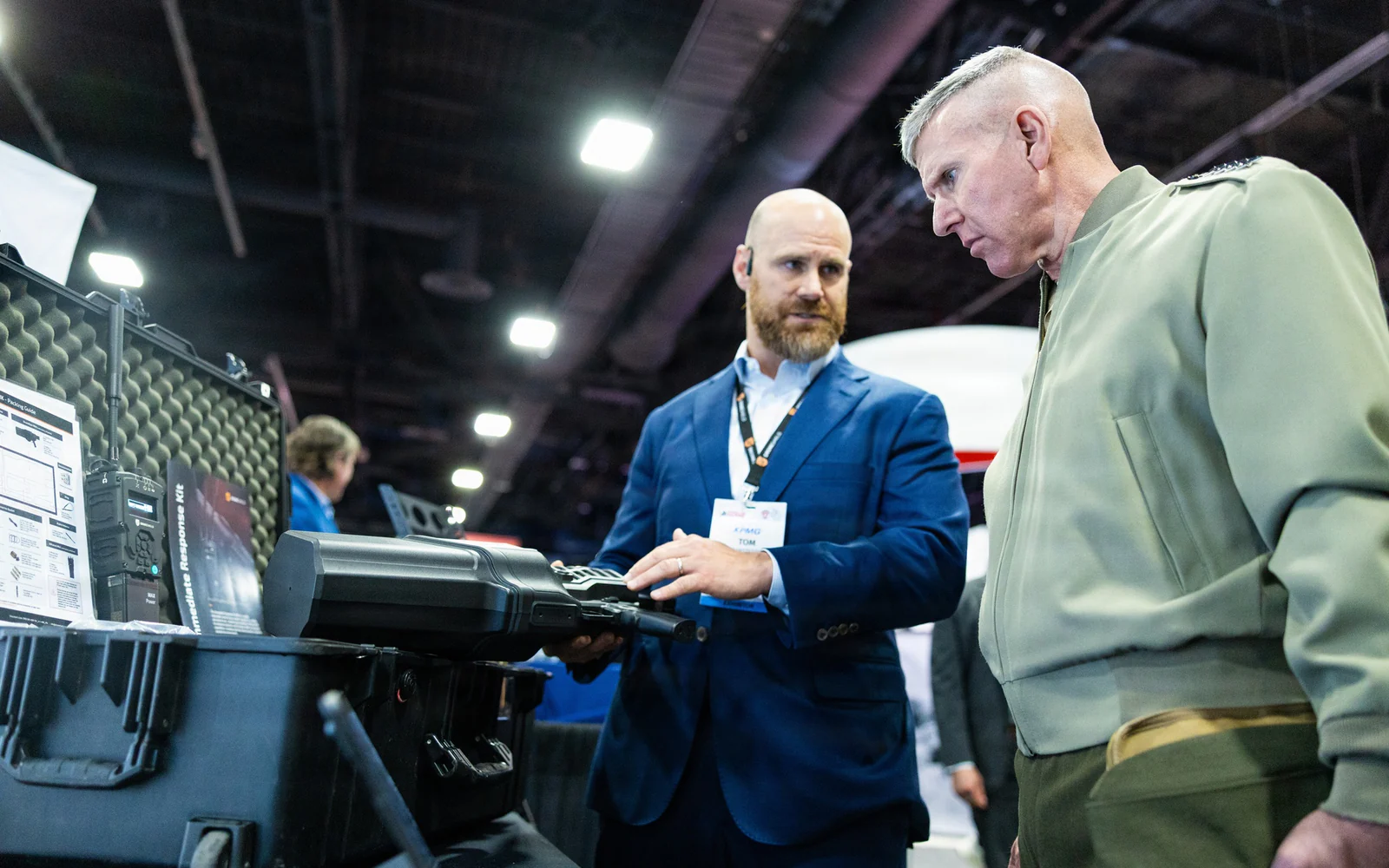
The lead image is a public-domain U.S. Marine Corps photograph by Cpl. Juaquin Greaves from the Defense Visual Information Distribution Service (DVIDS). It depicts a counter-UAS exhibit at Modern Day Marine 2026, not UVID Dronetech, and is used only to illustrate the trade-show setting and technology category. The photograph's appearance does not imply endorsement.
Organizer descriptions, participant announcements, and government delegation plans are attributed to their publishers. Audience-fit judgments, buyer questions, and due-diligence checklists are editorial analysis. This article does not claim firsthand attendance, test any exhibitor's system, endorse a supplier, or guarantee future program and travel conditions.
Last checked: September 2, 2026.