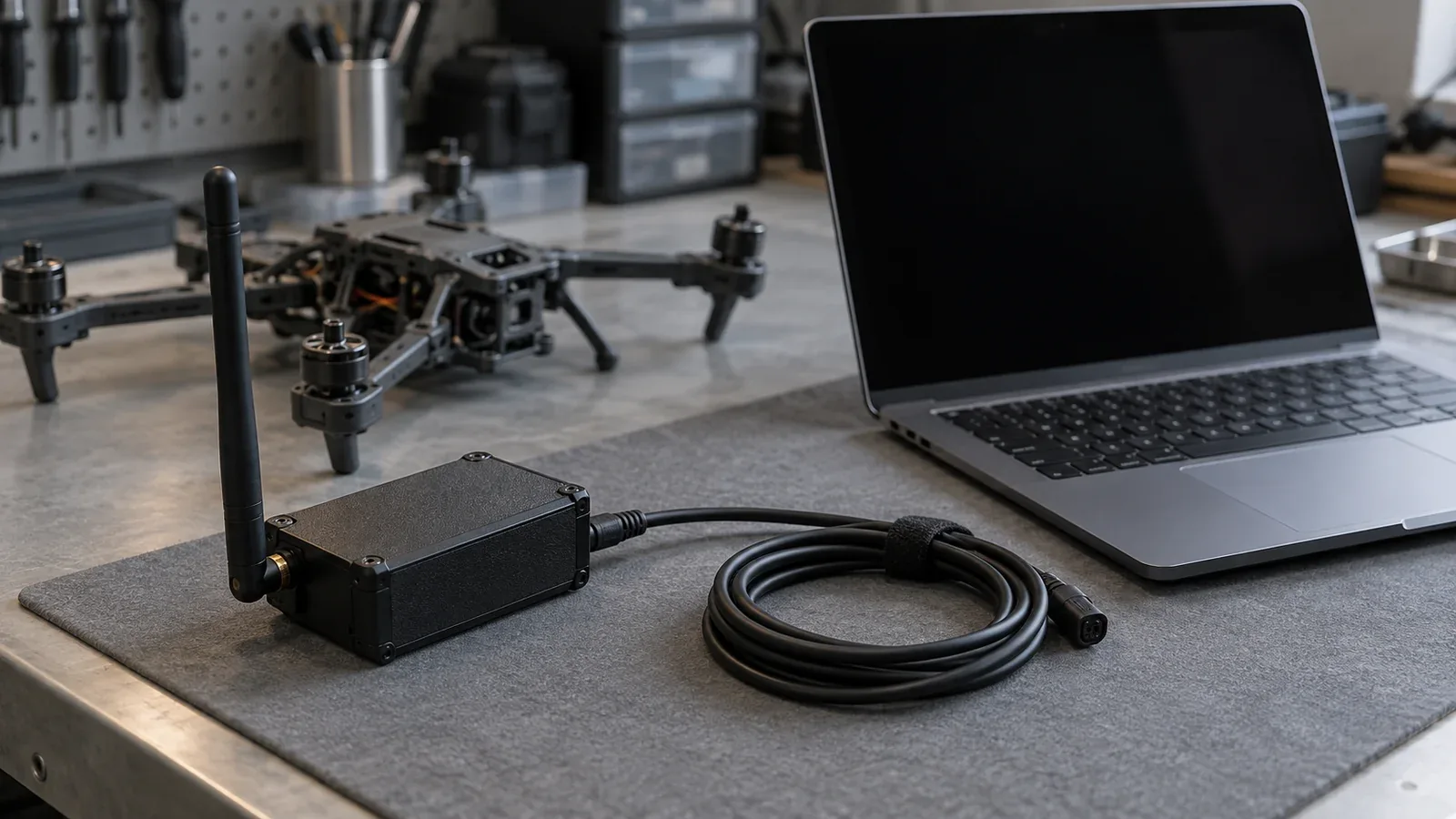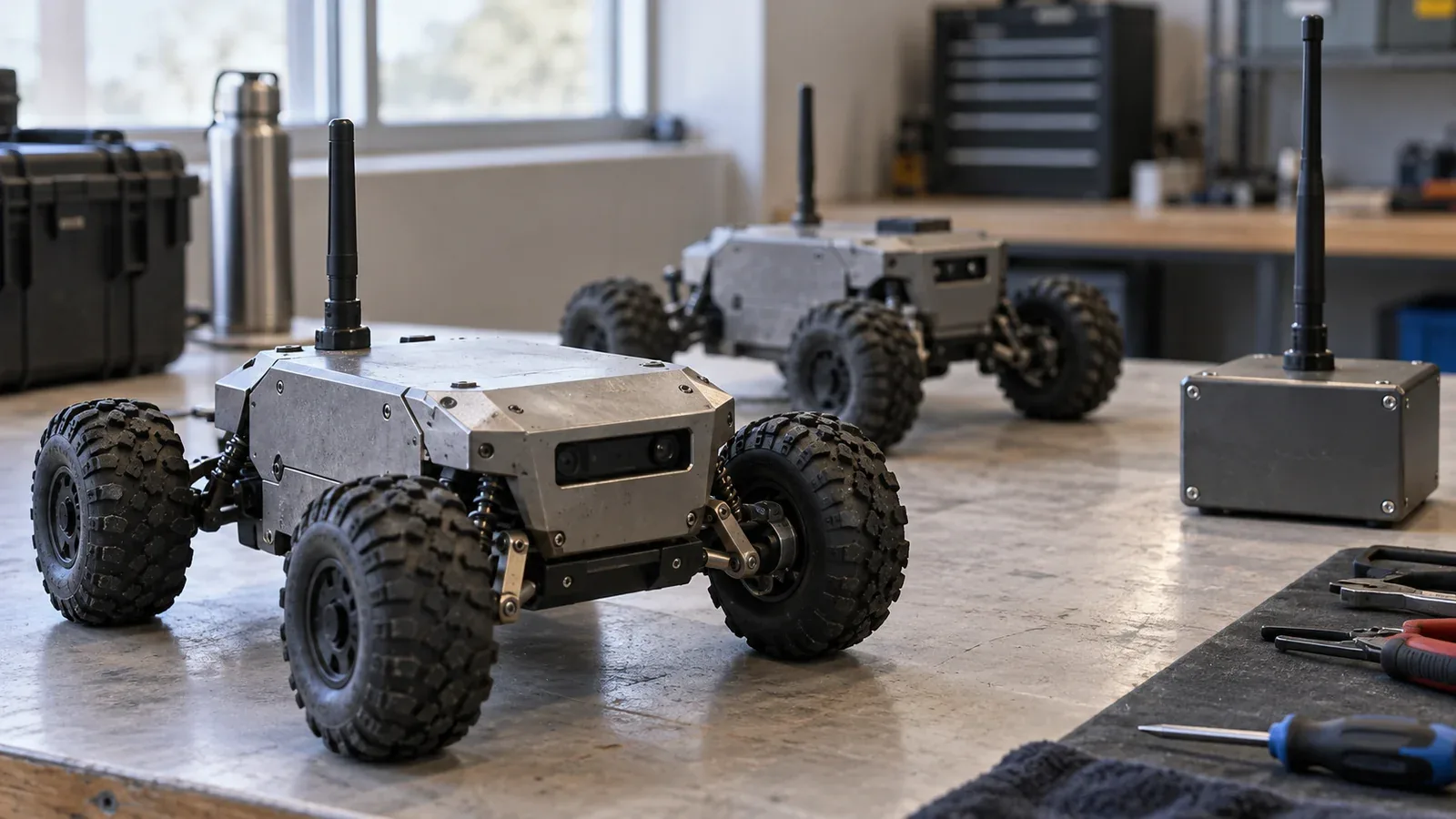
Swarm robotics coordinates a group of robots through decisions made by individual robots using nearby observations and interactions. Each robot runs its own control logic; the group's pattern of movement or work emerges from those repeated decisions. This can distribute sensing and effort across an area without requiring a central computer to calculate every robot's next move.
The qualification is the system boundary. Decentralized movement can still depend on a shared mission file, positioning service, radio network, or operator interface. To understand a swarm, trace both where decisions happen and where the information needed for those decisions comes from. The distinction between local computation and communications architecture is illustrated in the research implementation Swarm-Enabling Technology for Multi-Robot Systems.
On This Page
- Where the controller went
- How local rules produce coordinated behavior
- Interfaces that make local decisions meaningful
- What changes when the swarm grows
- Failure modes beyond losing one robot
- Representative applications and demonstrated limits
- Choosing and evaluating a swarm architecture
Where the controller went
The controllers reside on the individual robots. A useful architecture description identifies which decisions each controller can make from locally available information and which decisions require outside input.
Separate three functions when examining a system:
- Mission definition: specifying the task, operating area, target pattern, or stopping condition.
- Collective coordination: deciding how robots distribute themselves, move together, or respond to a discovery.
- Individual motion control: converting a robot's chosen motion into motor commands using its own feedback.
These functions can reside in different places. Uploading one target shape before a run does not necessarily centralize the subsequent coordination. Conversely, putting a flight controller on every aircraft does not establish that trajectory planning is decentralized.
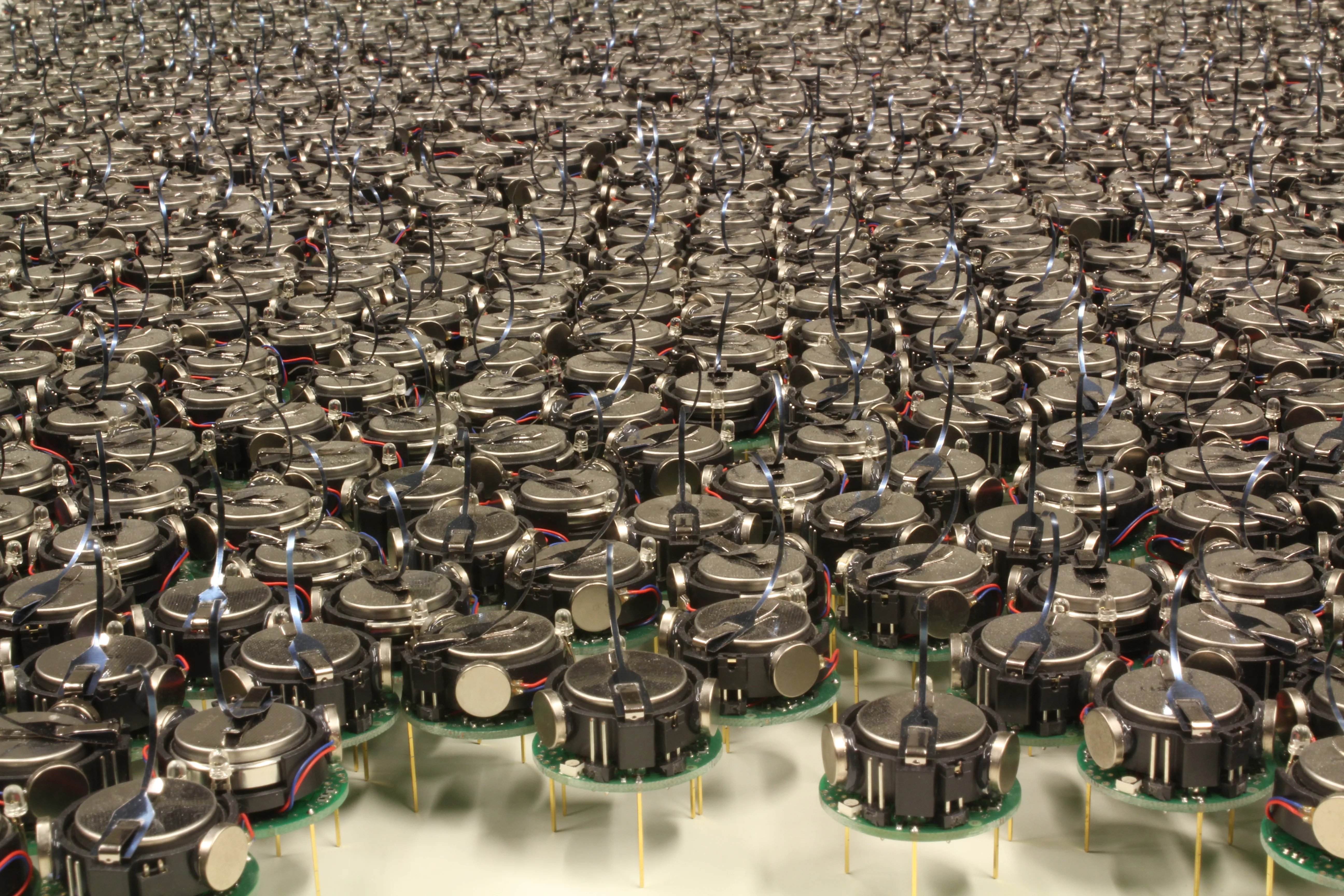
Harvard's 2014 Kilobot demonstration makes the distinction concrete. Four robots established a coordinate origin; the others received a target image and used local behaviors to assemble into its shape. The robots communicated with nearby peers through infrared and did not have a bird's-eye view. Initial common instructions and reference robots were part of the architecture even though the group required no continuing micromanagement.
For a supplier's proposed system, ask for a dependency drawing that identifies the mission source, every decision-making processor, and every shared service. Then ask what continues operating when each connection disappears.
How local rules produce coordinated behavior
The basic loop is to observe, update a local estimate, choose an action, move, and observe again. Several different coordination mechanisms can sit inside that loop.
Moving together
A flocking controller can combine tendencies to maintain spacing, align movement with neighbors, and stay near the group. The weights, sensing limits, and vehicle dynamics determine the resulting motion. Simply combining attractive and repulsive influences does not establish collision-free navigation through clutter.
Soria, Schiano, and Floreano's 2021 study instead incorporated local interaction objectives into predictive optimization that accounted for vehicle dynamics and the environment. The authors demonstrated their model with five quadrotors in an indoor obstacle environment. That result supports the particular tested approach; it does not turn a flocking rule into a universal safety guarantee.
Agreeing on a value
In consensus, robots repeatedly adjust a value using information from neighbors. The value might represent a shared estimate or a desired direction. One robot need not collect everyone's measurements in one place.
The Olfati-Saber, Fax, and Murray technical report explains how information flow, network structure, and delay affect agreement. Consensus requires the appropriate connectivity and update assumptions for the chosen algorithm. A group split into isolated components cannot exchange new information across the split; temporary interruptions may be tolerable under an algorithm's stated conditions.
Agreement is also different from accuracy. If robots exchange biased measurements, reaching similar values does not independently establish that those values describe the environment correctly.
Reacting to neighbors or environmental traces
Coordination need not use radio packets. In Harvard's Blueswarm research, underwater robots used cameras to observe LEDs on neighboring robots. Their local visual responses produced aggregation, dispersion, and circular movement.
Another mechanism, stigmergy, lets a robot change the environment so another robot can respond later. In the Phormica experiments, robots illuminated a photochromic surface with ultraviolet LEDs, creating colored traces that cameras could detect. Five robots were used in coverage, foraging, and tasking experiments. The physical surface stored the signal, so its visibility and fading behavior were part of the coordination system.
These mechanisms solve different problems. Motion alignment, shared estimation, and recruitment to a task are separate behaviors; demonstrating one does not establish the others. Recruitment also needs a stopping rule if only some robots are needed at the discovery. Otherwise, a response that successfully gathers the whole group may interrupt work elsewhere.
Interfaces that make local decisions meaningful
A useful integration review follows one neighbor observation all the way to the receiving robot's motion command. The following interface questions are engineering synthesis from the cited sensing, communication, and control examples, not a universal swarm message specification.
| Interface | What the receiving robot needs to interpret | Question to resolve before integration |
|---|---|---|
| Sensor to local estimator | Relative bearing, distance, obstacle observation, or own position | What frame, units, uncertainty, and detection limits apply? |
| Neighbor to coordination logic | Measured state, intended motion, or a task signal | Which is being sent, and how old may it be when used? |
| Local planner to motion controller | A feasible velocity, heading, or trajectory | What happens if the requested motion exceeds the vehicle's limits? |
| Shared service to robot | Mission parameters, map, clock, or positioning input | Can coordination continue when this service is unavailable? |
| Robot to supervisor | Health, progress, and the reason for degraded operation | Can the operator distinguish completed work from lost contact? |
For example, “position” is incomplete as an interface definition. A relative bearing in the observer's body frame cannot be substituted directly for coordinates in a shared map. Likewise, a neighbor's intended trajectory is not proof that the neighbor has physically followed it.
Specify the behavior when an input is missing as carefully as its normal meaning. A robot receiving no neighbor detections may be alone, occluded, out of range, or experiencing a sensor fault. The appropriate response depends on which conditions it can distinguish.
Task ownership needs equally clear semantics. As a design example, suppose two robots independently discover the same inspection job. A coordination protocol must distinguish discovering it, claiming it, and reporting it complete. It also needs a rule for releasing a claim when a robot leaves or fails. Otherwise, the group can either duplicate the job or leave it unfinished. This is a proposed interface scenario, not a reported result from the research examples.
There is no contradiction between local coordination and a supervisory display. The display becomes a central dependency when robots require its output to continue the behavior being claimed as decentralized. A practical demonstration should identify that boundary explicitly.
What changes when the swarm grows
Increasing robot count changes both the amount of work available and the amount of interaction. The useful scaling question is how completed mission output changes with robot count under comparable conditions.
Locality can limit each robot's immediate information load. But it is necessary to distinguish adding robots over a larger area from packing more robots into the same area. The second case can increase nearby traffic and physical interference.
For an illustrative message-accounting calculation, suppose each robot sends a separate update to every other robot once per cycle. With N robots, that is N × (N − 1) directed deliveries: 90 for 10 robots and 9,900 for 100. If each robot instead addresses six neighbors, 100 robots generate 600 deliveries per cycle. These are calculated application-level counts, not measured radio airtime; broadcasting, relaying, retransmission, and packet size change the network load.
The field experiments in Swarm-Enabling Technology observed imperfect communication among robotic buoys and more dropped messages as the deployed population increased. This is a reason to measure the actual network at the intended density, not rely on a radio's nominal range.
Local interaction also changes how quickly information can spread. The consensus report connects communication structure to convergence speed. Shortening every neighborhood to reduce traffic may slow the spread of a discovery or leave groups disconnected. Increasing update rate cannot repair a missing path between them.
For a coverage task, record area covered to the required sensing quality, elapsed time, duplicate coverage, energy used, and operator interventions. More robots circling the same patch is greater activity without necessarily greater mission output. These are proposed evaluation measures, not performance results from the cited demonstrations.
Failure modes beyond losing one robot
Redundancy helps only when the remaining robots can still perform the task and retain the dependencies they need. Use the following failure table to plan controlled evaluation. The failure mechanisms draw on the Kilobot, consensus, communication, and security sources; the checks are editorial engineering recommendations.
| Failure | Possible collective consequence | What to check |
|---|---|---|
| An ordinary robot stops | Reduced coverage or an obstacle for other robots | Whether work is reassigned and the stopped unit is avoided |
| A robot connecting two groups disappears | Information exchange between groups breaks | Whether either group detects isolation and how reconnection works |
| Neighbor data arrives late | Decisions use an outdated scene | Data expiry, degraded behavior, and end-to-end delay |
| Robots share a faulty positioning input or software defect | Multiple robots make related errors | Shared dependencies, rather than only random individual losses |
| Dense traffic produces a deadlock | Robots remain active but work stops | Progress detection and recovery under the intended density |
| A participant supplies false state | Local interactions carry misleading information into group behavior | Participant authentication and checks on the plausibility of its reports |
The Chen and Ng security preprint treats emergent behavior as a security concern beyond ordinary network connectivity. It proposes a method for identifying rogue robots under a communication model. It is not a certification or proof that an arbitrary swarm is secure.
As an integration implication, identifying the sender and trusting the measurement are separate questions. An authorized robot can still have a faulty sensor. Similarly, a health dashboard can show that processors are alive while the group makes no progress.
Fail-safe behavior must also be coordinated with the operating environment. For an aircraft, holding position, landing, and leaving the active area are different responses with different effects on neighbors. Define the response for the particular platform and verify it in simulation and controlled trials before relying on it operationally.
Representative applications and demonstrated limits
Swarm research spans different environments, but the examples establish different capabilities.
Ground self-assembly and algorithm research: Harvard's 2014 experiment used 1,024 Kilobots to form programmed shapes. Its local correction behaviors addressed problems including jams and positioning errors. This is evidence of large-scale physical self-organization under the experiment's conditions, not evidence of outdoor mobility or useful industrial payload capacity.
Coordinated aerial motion: Vásárhelyi and colleagues' 2014 research demonstrated outdoor flocking and formation tasks with up to ten aircraft. The aircraft used GPS and locally shared position information by wireless communication. The authors assessed larger groups in simulation. The important architectural lesson is that decentralized flight decisions can coexist with a common positioning dependency; the physical demonstration and simulated scale should be reported separately.
Underwater collective search: In the Blueswarm tank experiment, robots dispersed until one detected a red light, then signaled with flashing LEDs to recruit the others. That sequence illustrates how a discovery can change a group's behavior without an external motion controller. It remains a controlled search demonstration, not evidence of reef-monitoring performance in turbid water or currents.
Coverage and task signaling: Phormica demonstrated how persistent environmental traces can influence subsequent robot activity. Applying that idea elsewhere requires an environment in which a usable trace can be deposited and sensed. It cannot be assumed to transfer unchanged from a prepared laboratory floor to arbitrary terrain.
These examples are useful starting points for environmental sensing, distributed inspection, and search concepts. A mission proposal still has to connect the demonstrated collective behavior to the required sensing quality, operating conditions, and completed work.
Choosing and evaluating a swarm architecture
Consider a decentralized swarm when the task can be divided among robots and local information is sufficient for useful progress. If every action requires a fresh global assignment or tightly scheduled access to a shared resource, compare it with centralized or hierarchical coordination before committing to the swarm approach. This is an architectural selection judgment, not a claim that one approach always performs better.
Request a demonstration that answers five concrete questions:
- Where are mission decisions, coordination decisions, and individual control computed?
- Which positioning, communications, and infrastructure services must remain available?
- What changes when robot count and deployment density increase separately?
- What happens when a robot stops, a group becomes isolated, or shared information becomes unreliable?
- How is successful work measured independently of orderly movement?
A useful swarm specification names the local information available to each robot, the collective behavior that information supports, and the conditions that break the relationship. Those details make “without a central controller” an assessable engineering claim.
Sources
- Swarm-Enabling Technology for Multi-Robot Systems: original research on local processing, distributed communication, and field communication behavior, 2017.
- A self-organizing thousand-robot swarm: Harvard's institutional account of its 2014 Kilobot experiment, including initialization, local sensing, and error correction.
- Predictive control of aerial swarms in cluttered environments: research article abstract documenting the predictive approach and five-quadrotor indoor experiment, 2021.
- Consensus and Cooperation in Networked Multi-Agent Systems: Dartmouth technical report TR06-004, April 2006, explaining consensus, information flow, delay, and network structure.
- Robotic swarm swims like a school of fish: Harvard's institutional account of Blueswarm's visual coordination and tank search demonstration, 2021.
- Phormica: Photochromic Pheromone Release and Detection System for Stigmergic Coordination in Robot Swarms: original research on environmental signaling and five-robot experiments, 2020.
- Securing emergent behaviour in swarm robotics: Chen and Ng's 2021 preprint on swarm communication security; its proposed protections are model-specific.
- Outdoor flocking and formation flight with autonomous aerial robots: authors' IROS 2014 research manuscript documenting GPS-assisted decentralized flight and distinguishing physical trials from larger simulations.
Last checked: September 8, 2026.